Holon
50% reduction in analysis effort and 20x faster computation through code optimization. Breaking free from legacy device control software.
| Company name | Holon Co., Ltd. (A&D Holon Holdings Group) |
| Industry | Semiconductors & Precision Equipment |
| Business Type | Manufacturing |
| Business Description | Development, manufacturing, and sales of Semiconductor design circuit dimension measurement, including electron beam measurement devices. |
| Company size | 59 employees |
| System Types | Semiconductor design circuit dimension measurement control software, image processing systems, automation tools, and more |
Interview Participants
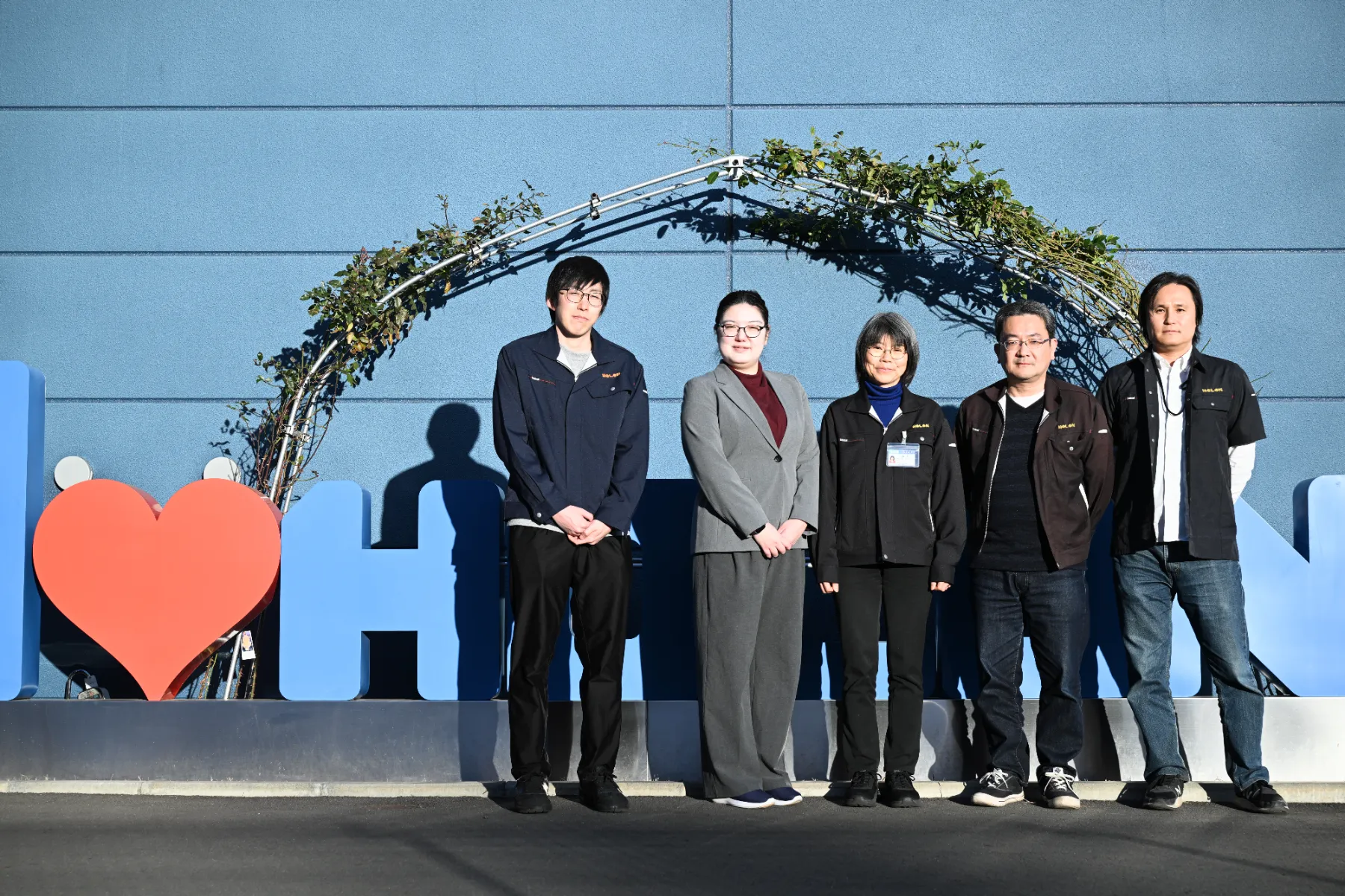
| Holon Co., Ltd. | Masahiro Onozawa, Senior Engineer, 2nd Design Department Izumi Santo, Manager, 2nd Design Department Mirai Anazawa, Deputy Manager, 2nd Design Department Syoji Yamashita, Section Chief, 2nd Design Department |
| Jitera | Ruri Sakamoto, Customer Success Team |
Challenges
Key personnel responsible for long-operated device control software were no longer available, making it difficult to understand legacy code and perform maintenance.
Using general-purpose generative AI posed security risks, as the source code is sensitive and could not safely be used for AI training or analysis.
Impact After Introducing Jitera
Analysis of image processing bottlenecks improved processing speed by approximately 20x compared to the original.
Effort for understanding existing code and creating design documentation was reduced by up to 50%.
Customer tool creation, from GUI implementation to manual generation, was reduced from one full day to just one hour.
Previously opaque external driver behavior was analyzed, resolving long-standing technical issues.
Future Outlook
Build a knowledge-sharing platform across projects.
Establish a secure and seamless development workflow integrating on-premises environments such as GitLab.
Business Overview and Reason for Adopting Jitera
Background: Holon develops and manufactures Semiconductor design circuit dimension measurement using electron beam technology. Their devices are primarily used for measuring and inspecting photomasks (semiconductor circuit masters), requiring extremely high precision to detect nanoscale defects.
Challenge: Legacy systems and high-precision requirements made maintenance and modernization difficult, prompting the adoption of Jitera’s AI-powered development platform.
Why a Hardware Manufacturer Adopted Jitera
Santo: While our devices are hardware, controlling them and processing image data relies heavily on software. Our 2nd Design Department handles development and maintenance, but “legacy code being tied to individual knowledge” was a major challenge. Many devices have been operating for years, and the engineers who originally developed the software are no longer available. As a result, complex code exists whose specifications are difficult to interpret. Maintaining or adding features required spending significant time just understanding the existing code.
Additionally, the company has a top-down policy of actively adopting new technologies, and we began exploring AI to improve development efficiency. However, we faced a dilemma: we wanted to boost efficiency but could not compromise security, as our source code is highly confidential and could not be uploaded to unsecured, free AI tools.
Why Jitera Was Chosen
Santo: The key reasons were security and context understanding. We experimented with free, general-purpose AI tools, but these posed security risks for our proprietary source code. Jitera provides a secure environment that allows our internal repositories to be safely analyzed. This security assurance was essential for enterprise AI adoption.
Another major factor was Jitera’s ability to understand context, not just generate code. It can interpret Holon-specific coding practices and parameter usage, allowing it to analyze and generate outputs tailored to our existing legacy assets. This capability to work effectively with proprietary, long-standing code was a critical differentiator over general-purpose AI tools.
Implementation Process and Project Structure
How Jitera Was Introduced and Applied
Santo: Within the 2nd Design Department, we started using Jitera with a few key members responsible for specific functions, such as image processing, automation features, and driver control. We moved beyond the initial “let’s try AI” phase and began applying Jitera directly to real business challenges, including legacy code analysis and new feature implementation, while validating its effectiveness in our workflows.
Support and Adoption
Onozawa: Jitera’s support went beyond simple operation guidance. We were able to discuss practical, hands-on usage that aligned with our daily tasks, which clarified how to integrate it into our workflow. Additionally, Jitera’s fast feature updates were helpful — monthly meetings allowed us to stay up to date with the latest capabilities.
Santo: Beyond group meetings, the one-on-one support sessions were particularly valuable. Each engineer faced unique technical challenges, and having dedicated time for individualized consultation helped ensure smooth adoption and effective integration into daily operations.
Impact After Introducing Jitera
Efficiency in Code Analysis and Documentation
Yamashita: I handle feature additions to existing code, and Jitera has dramatically reduced the effort needed for understanding specifications and creating documentation. By analyzing existing functions and generating flowcharts or explanations, Jitera allows us to cut code analysis time by up to 50%, letting engineers spend more time designing rather than just reading code.
Performance Optimization
Jitera has also delivered results in optimizing image processing functions. For complex operations like vector calculations, we instructed it to speed up the processing without changing input or output. The AI-generated code leveraged multi-threading and other optimizations, boosting processing speed to roughly 20x faster than the original. This performance surpasses what manual tuning could achieve.
Accelerated Customer Tool Development
Onozawa: Creating customer-facing tools used to take a full day, but with Jitera, even including trial and error, it now takes just one hour. Jitera generates not only code but also manuals in one go, allowing us to respond to customers faster and more efficiently.
Solving Long-Standing Challenges
Anazawa: Jitera helped resolve previously “unsolvable” issues. For an external vendor driver that had become a black box, it was able to identify where administrator privileges were requested, enabling precise fixes from the vendor and resolving long-standing operational problems.
Continuous Learning and Trend Awareness
Santo: Another major benefit is that Jitera allows us to keep up with the latest AI trends and learn from other companies’ use cases through support meetings. Tracking this information on our own would be difficult, but Jitera effectively “runs alongside us,” helping us continuously innovate while developing.
Future Use of Jitera
Cross-Project Knowledge Sharing
Santo: Currently, each engineer uses Jitera for their individual tasks, but we aim to create a framework to share knowledge across projects, ensuring insights and best practices are accessible company-wide.
Integration with Internal Systems
Onozawa: We’re particularly excited about the beta MCP (Model Context Protocol) server integration. Connecting Jitera directly with Office products like Excel and Word will further streamline document creation, and we plan to leverage this capability extensively.
Accelerating Development and Embracing AI
Santo: With the rapid AI shift in the industry, adopting new technologies is essential. Jitera has already boosted our development speed, and we intend to continue using it boldly to enhance product quality and innovation.