Daikyo System
Accelerate consensus with modernization techniques that instantly generate 80% complete UI code.
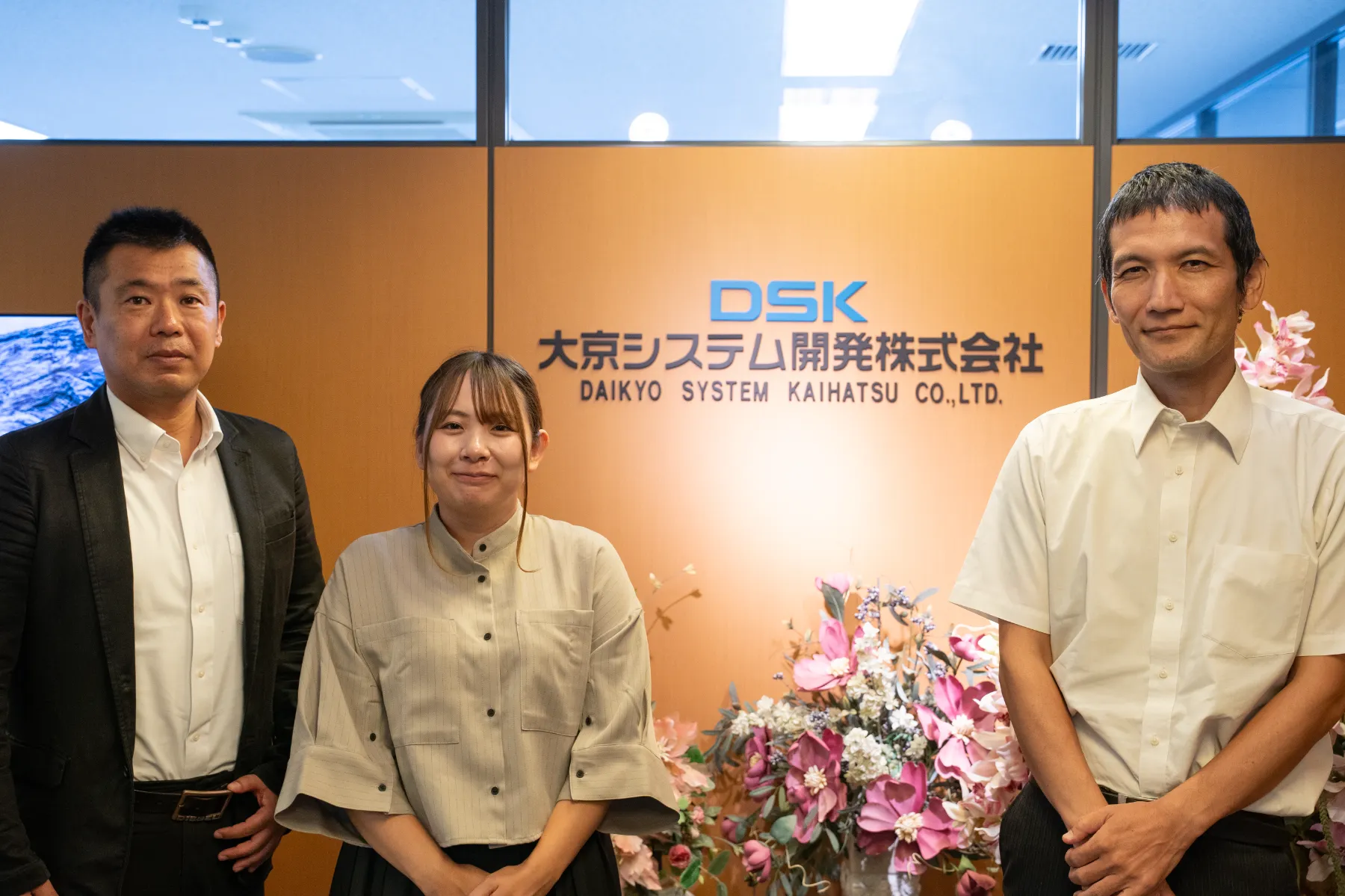
| Company name | Daikyo System Development Co., Ltd. |
| Industry | IT Services |
| Business Type | Information Systems / IT Services |
| Company size | 255 employees (31 women / 12.2 percent) including subsidiaries |
| System Types | Business system development, web application development, and more |
Interview Participants
| Daikyo System Development — Systems Division | Taisuke Kuritani, Head of Second Systems Department Kazuhiro Uemura, Assistant Manager, First Systems Department Misaki Shinsako, Section Chief, First Systems Department |
| Jitera | Yusuke Nakajima, Head of Customer Success and Pre-sales (Japan) |
Challenges
Existing analysis work became a major bottleneck, requiring many engineers and long hours, putting pressure on delivery timelines and workload reduction.
Rapid increase in modernization projects made it difficult to secure engineers during the early analysis phase of projects.
Security concerns around using generative AI, particularly the risk of customer data, system specifications, and source code being leaked or used for external training.
Results After Introducing Jitera
A secure AI foundation with opt-out measures enabled safe AI usage even for projects handling sensitive customer data.
Existing internal assets (repositories) could be directly used within Jitera’s RAG.
Tasks that previously required 3–4 engineers could now be handled by a single engineer during pre-assessment.
Modernized UI images were generated automatically, reaching roughly 80 percent completion in a short time, reducing creation time from one day to about two hours.
Answer accuracy improved with continued use, enabling smooth adoption in real development environments.
Engineers could handle unfamiliar domains, spend more time delivering value to customers, and improve overall service quality.
Future Outlook
Continue focusing on modernization projects for legacy systems such as mainframes, office computers, and Visual Basic applications.
Expand knowledge gained by the PoC team internally to train and increase the number of engineers capable of using AI agents.
Establish standardized project management and effort estimation using AI agents.
Leverage the partnership with Jitera to provide higher-value services and expand consulting services that support customers’ AI agent adoption.
Business Overview and Reason for Adopting Jitera
Please tell us about your business.
Mr. Kuritani: We are an IT vendor focused on system development, providing business systems, sales management, production management, and logistics solutions to a wide range of industries. Recently, demand for migrating and modernizing legacy systems such as COBOL and Windows-based applications has increased significantly, and we focus on solving these challenges.
Why did you decide to introduce Jitera?
Mr. Kuritani: Our president strongly believes AI will be essential for future business. We initially explored general generative AI, but since our core business is system development, we were looking for an AI specifically designed for developers and that’s how we found Jitera.
Why Jitera Stood Out
Mr. Kuritani: Many clients lack proper documentation, so reverse engineering existing systems is often required. Finding AI capable of handling not only modern languages like Java but also legacy languages such as COBOL is rare. Jitera’s ability to support both was a major advantage.
Key Reasons for Choosing Jitera
Security
Jitera uses a secure AI platform with opt-out contracts, ensuring that proprietary knowledge, system specifications, and source code are never learned or shared externally. The ability to create a persistent, company-specific RAG was highly valued.
Ease of Using Existing Assets
Jitera can generate RAG directly from existing repositories and Git assets, enabling immediate use in real development environments.
Implementation Process
A small PoC team was formed to validate Jitera’s use in:
- Existing projects
- Modernization initiatives
- Standardizing project processes and effort estimation
- Promoting internal adoption and training
Knowledge was intentionally shared internally using a “champion user” model to spread expertise efficiently across teams.
Benefits and Differentiation
Faster setup compared to other AI tools, projects can start within three hours of preparation.
Higher response accuracy due to RAG built from internal assets.
Secure handling of sensitive data.
Enables engineers to save time, improve quality, and focus on creative work.
Post-Implementation Impact
In a VB.net to Java web modernization project, Jitera reduced preparation work from 3–4 engineers to just one.
HTML UI creation time dropped from one day to about two hours.
PDF-based UI specs could be uploaded and analyzed instantly, producing drafts up to 80 percent complete.
With proper instructions, Jitera achieved up to 60 percent modernization progress including backend logic.
Engineer Feedback
Engineers now rely on Jitera daily, using it as a trusted assistant rather than just an AI tool.
Seeing the reasoning process behind responses helps engineers learn and refine instructions.
Accuracy improves with continued use and better communication.
Expanding Engineer Capabilities with AI
Initial concerns about job reduction quickly disappeared. Engineers now use AI to code, review, refine, and iterate, freeing up time to focus on customers. Engineers can also work in previously unfamiliar technologies like React and Vue.js using Jitera-generated samples.
Future Use of Jitera
Daikyo plans to scale modernization efforts, increase AI-enabled engineers, and introduce Jitera to customers as part of broader consulting services.