CAC
AI-Powered Knowledge Transfer and Engineer Training: Cutting Documentation and Review Time by 70%
| Company name | CAC Inc. |
| Industry | IT Consulting |
| Company size | 1327 employees |
| Client industry | Finance, Bio, Manufacturing |
Interview Participants
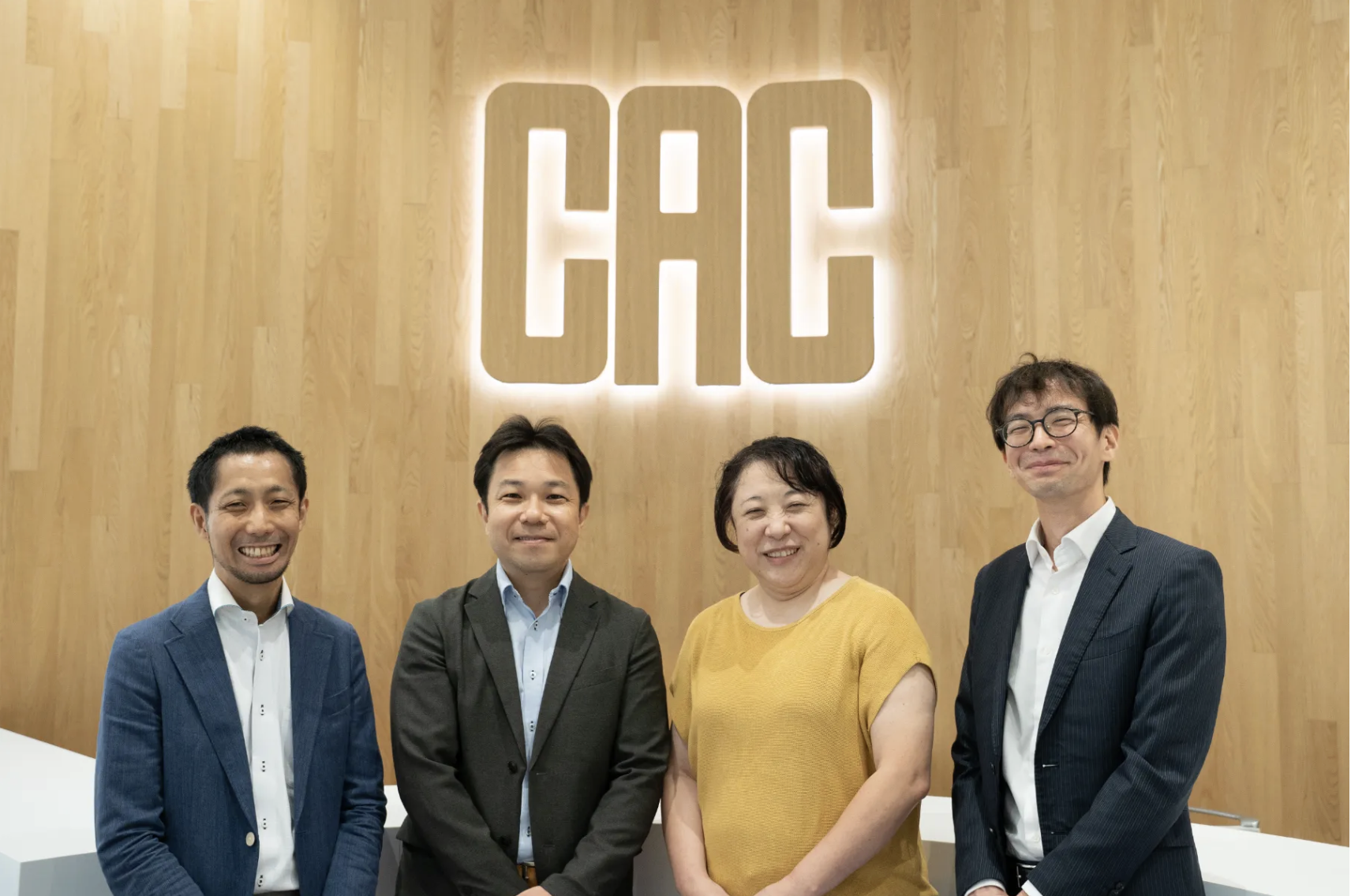
| CAC | Tatsuo Nakagawa, Service Producer, Integration Headquarters Minako Asami, General Manager, Financial Business Division 3 So Fujio, Integration P&S Department Hitomi Fukaya, Financial Business Division 3 |
| Jitera | Yusuke Nakajima, Head of Customer Success and Pre-sales (Japan) |
Challenges
A wave of retirements among veteran engineers with deep business knowledge made knowledge transfer and next-generation talent development an urgent priority.
Modernizing legacy systems required specialized reverse-engineering resources that were increasingly difficult to secure.
Engineers maintaining large-scale financial systems had limited opportunities to adopt and apply new technologies within their day-to-day work.
Results
70% reduction in effort during the design documentation phase by leveraging reverse engineering directly from existing source code.
Enabled accurate reverse engineering even by team members with no prior assembler language experience.
Provided an intuitive AI-driven platform that allowed engineers with no AI background to contribute immediately, expanding the available talent pool and accelerating time-to-productivity.
SaaS-based knowledge capture and sharing allowed new members to onboard quickly and begin contributing to projects without delay.
Looking Ahead
Expand adoption beyond PoC validation into implementation and testing phases, while driving standardization of development processes.
Strengthen in-house development capabilities for client companies through comprehensive process support.
Through the strategic technology partnership between CAC and Jitera, continue to share expertise across technical and business domains, creating new value for organizations and society at large.
Company Background and the Decision to Adopt Jitera
Could you tell us about your company and its business?
Mr. Nakagawa: Founded in 1966 as Japan’s first independent software company, we are now a core company of the CAC Holdings Group. As an independent IT services firm not tied to any specific manufacturer or capital group, we have built our business on strong technical expertise and deep industry knowledge across finance, pharmaceuticals, and manufacturing. Based on this foundation, we provide a wide range of clients with system development, operations, and BPO services.
In recent years, the CAC Group has focused heavily on research and development around “AI that empowers people.” From this initiative, we have launched multiple new businesses built on AI-driven products. In April of this year, we further accelerated this momentum by spinning off our New Business Development Division into a standalone company dedicated to advancing these initiatives.
What led you to adopt Jitera?
Mr. Nakagawa: I had long been exploring how generative AI (LLMs) could be applied to our core domain of system development and maintenance. While there are many tools that generate source code from prompts — often producing results good enough to be refined with human review — I noticed a significant gap.
There were still very few effective tools that could support the upstream phases of system development, such as requirements definition and design. One major reason is that the tacit knowledge in people’s heads and the documents created for team development, while human-readable, are not always structured in ways that AI can easily analyze.
In searching for a more effective approach, I came across Jitera. What stood out was its ability to leverage AI across the entire system development lifecycle — from generating design documents to producing source code — making it possible to drive efficiency throughout the process, not just at isolated points.
Challenges Before Adoption and Why Jitera Was Chosen
Mr. Nakagawa: Toward the end of 2024, I conducted internal interviews to see if there were areas where generative AI could be applied. In response, Mr. Asami mentioned the pressing issue of modernizing legacy systems. The very first solution that came to mind was Jitera.
What specific challenges were you facing?
Mr. Asami: For members responsible for maintaining large-scale financial systems, there is often little change in the systems they manage, even as technology continues to advance rapidly around them. This environment can make it difficult to stay sensitive to new innovations. Yet, I felt strongly that creating opportunities to engage with generative AI was essential for our engineers to increase their professional value.
At the same time, while our company has long built its business on deep domain knowledge, many of the members who hold this expertise and track record are now approaching retirement age. This presents a major challenge for us in terms of knowledge transfer and sustaining our competitive advantage.
Why Jitera Was the Right Choice
What was the deciding factor in choosing Jitera?
Mr. Asami: When I attended the initial briefing on Jitera, I was struck by just how much it could do. It’s not easy to ask engineers nearing retirement to learn entirely new technologies from scratch, but with Jitera, the concepts are accessible and the learning curve is far less steep.
As I mentioned earlier, the aging of our experts poses a serious challenge. In an environment where Japan is facing a shortage of engineers, I believe Jitera offers a way to connect our members’ deep business knowledge with modern AI technology, allowing them to remain active contributors for longer.
Another point that appealed to me is how Jitera reframes legacy system modernization. Typically, it’s seen as “cleaning up the past” — a burden. With Jitera, it becomes a forward-looking opportunity to learn contemporary technologies and AI skills, which is far more motivating for engineers.
Mr. Nakajima: That’s exactly what we mean by “AI that empowers people.” From a motivation standpoint, being able to acquire generative AI skills while working on modernization is far more engaging than simply rebuilding the same functions. In that sense, AI-powered modernization is extremely effective.
Mr. Asami: I agree. I see enormous potential not only for our company but also for our client organizations in the combination of experienced, retirement-age engineers and Jitera.
Implementation Process and Jitera’s Support
Could you tell us about the three-month trial period that led to the formal agreement?
Mr. Fujio: We used Jitera in a project where the goal was to reverse engineer a client’s service and produce design documentation. The broader objective was to migrate from Assembler to Java, starting with visualizing the existing specifications.
Although the source code existed, it was extremely difficult to interpret, and there were no engineers with expertise in Assembler. On top of that, I was the only one with prior experience using generative AI for reverse engineering. That was the situation we started from.
How did you proceed in practice?
Mr. Fujio: During the first month, I spent time experimenting with Jitera, learning how to use it and exploring its potential. Gradually, I began to see promising results, and I grew confident that reverse engineering would be possible.
In the following two months, we tested whether the process could be applied by newly assigned team members. These members had no knowledge of Assembler and were also using Jitera for the first time. It was an opportunity to validate whether the process we had built was truly effective.
How did you find Jitera’s support during the trial period?
Mr. Fujio: Whenever we encountered issues — including very basic questions about how to use generative AI — Mr. Nakajima and the Jitera Customer Success team responded quickly and thoroughly.
Of course, given that we are using generative AI, there are some limitations in the current product that cannot yet be fully resolved. We’ve provided feedback on these points, and we look forward to seeing further improvements going forward.
Results After Adopting Jitera
What kind of results have you seen since adopting Jitera?
Mr. Asami: Although we are still in a PoC stage rather than full-scale deployment, we measured the time required to create design documents with and without Jitera. The result was a reduction of about 70% in work time.
When using Jitera with LLMs, the system clearly shows which lines of source code correspond to which parts of the generated design. This makes it possible to trace and confirm relationships while reviewing the Japanese-language design documentation. By working in this way — like a designer and reviewer collaborating — we were able to significantly reduce the burden on the designers.
Mr. Nakajima: So the traceability makes it easier to review, correct?
Mr. Asami: Exactly. For example, if certain conditions were missing, tracing line by line immediately reveals where the gap is. By combining human input with Jitera, we can ultimately push accuracy to nearly 100%.
Mr. Fukaya, how was your experience actually using Jitera?
Mr. Fukaya: For engineers who have never used generative AI, Jitera is approachable and easy to adopt with confidence. Even in reverse engineering, it produces highly accurate results without requiring specialized knowledge of a particular programming language, and the generated design documents are almost indistinguishable from those created by humans.
In addition, Jitera’s chat function allows us to ask for advice directly, which means engineers don’t need deep AI expertise — Jitera itself provides sufficient support.
A 70% reduction in workload is a major result. That must raise expectations for future development.
Mr. Fujio: Yes. The ~70% reduction figure came from a case where an experienced engineer — someone with a track record in design work on other projects — used Jitera during the reverse engineering design phase. For younger engineers in their second or third year, the first one or two functions still take about as long as traditional reverse engineering.
However, since we now have AI-generated drafts to work from, and since review is so much easier, productivity improves dramatically within just one or two weeks. At that point, even junior engineers can perform design work at a level comparable to veterans. While further validation is needed, we strongly feel that this is not an exaggeration but a very real, achievable outcome.
Why Choosing Jitera Was the Right Decision — Differences from Other AI Agents
In what ways does Jitera differ from other AI agents?
Mr. Nakagawa: When comparing Jitera with other AI agents, what stands out is that most alternatives are heavily oriented toward coding. While it isn’t impossible to use them for design tasks, they require you to provide extensive context in advance. That means the users themselves have to spend significant effort gathering and preparing the necessary information — and even then, they must also figure out where and how to store it for reuse.
Jitera, on the other hand, allows knowledge to be stored and shared within the platform itself, while still enabling updates using contextual information. It creates an environment where information is shared in real time, and where users can query the accumulated knowledge directly. This concept of “storing” knowledge within the tool is extremely valuable for us as a team-based development organization.
Mr. Fujio: Traditionally, expertise remained siloed, and the only way to share it was by passing around files. With Jitera, knowledge is accumulated in the cloud as part of the SaaS platform, making it immediately available to new members. The ability to both accumulate and share knowledge seamlessly in a single tool is a major advantage.
Future Utilization of Jitera
Mr. Asami: During the three-month trial, we focused primarily on reverse engineering. Going forward, we plan to extend our validation to the implementation and testing phases, with the goal of standardizing the entire development process internally. On top of that, we aim to package our expertise — such as assessments, process planning, and prompt design — so that we can provide it comprehensively to client proposals and contracted projects. Our target is to advance these initiatives by the end of this year.
Beyond the client where we conducted the PoC, many other companies face similar challenges. We believe Jitera can play a significant role in helping them resolve those issues quickly and accurately. By driving more efficient development, we want to ensure that the time saved can be redirected toward new initiatives and added value creation. In addition, some of our financial-sector clients are pursuing in-house development, and we intend to actively support those efforts as well.
The technology partnership agreement between CAC and Jitera ensures that we will continue to share knowledge and receive guidance, enabling us to move forward together.
Mr. Nakajima: As a partner, Jitera is fully committed to supporting these efforts. We also plan to release new features throughout the year, and we look forward to seeing you make the most of them. Thank you very much for taking the time to speak with us today.